

AI for Chartered Accountants in India: a ground report
·Team Miror·10 min read
Contents
AI for Chartered Accountants in India: a ground report
On 1 April 2026 the Income-tax Act 1961 was repealed. Every practising CA in the country is now working through the first year of a statute with 536 sections where there used to be 819, in which the assessment year no longer exists. That happened three and a half months ago, and most of the software, templates and internal notes in Indian practices still refer to the old numbering.
We have been speaking to CA firms in India about where their time actually goes. This post is a plain account of what they told us and what the rules themselves say: what the portals now demand that they did not demand two years ago, which parts of the job the models genuinely take over, and which part of the practice will not move no matter how good they get.
The portal now decides before you do#
The common belief about compliance automation is that the obstacle is submission. For a CS filing to the MCA that is broadly true, and we set out why in AI for company secretaries in India. For a CA in 2026 the obstacle has moved, and it has moved earlier in the month.
The Invoice Management System became mandatory on 1 October 2025. Every B2B invoice a supplier saves in GSTR-1 now appears on the recipient's IMS dashboard, and only accepted records flow into GSTR-2B. Taking no action counts as acceptance. GSTN sets this out in its revised advisory.
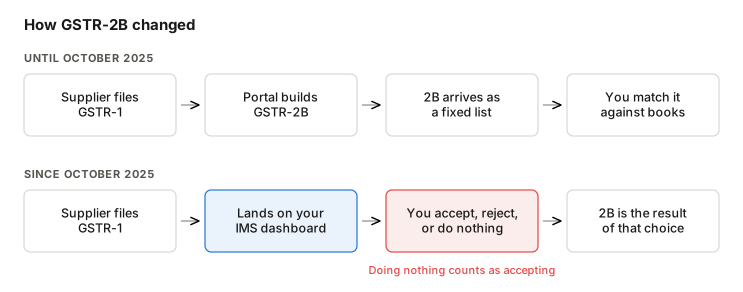
Read that twice, because it inverts something practitioners built their whole workflow on. GSTR-2B used to be an independent dataset handed down by the portal, which a firm could match its books against. It is now a product of decisions the firm itself made, or failed to make, in the preceding weeks. A firm that ignores the dashboard has not deferred the work. It has silently accepted every invoice on it.
The effect is sharpest on clients who sell through marketplaces, where invoice volume is high and the TCS credits arrive on a schedule of their own. We looked at that problem from the brand's side in AI for D2C brands in India, and the same mismatch that shows up in a firm's 2B reconciliation shows up there as a settlement file nobody can decompose.
Table 3 of GSTR-3B has been locked since the July 2025 period, so a figure that looks wrong cannot be corrected where it appears. It has to go back through GSTR-1 or GSTR-1A, as ClearTax documents. The correction path runs upstream now, not downstream.
What has not changed is the signing. The income tax portal signs through emSigner, which still expects a 32-bit Java 8 runtime on the machine holding the token, and the department's own DSC guidance walks through the setup. TRACES keeps a separate DSC registration and its own KYC validation. Anyone who has worked a season knows the two errors without looking them up. That step is physical, it sits in a USB port, and a person has to be in the room. If a vendor tells you their AI files returns end to end, the question that settles it is which machine holds the token.
So the honest picture is not that a portal blocks automation. It is that the portal now asks a firm to make thousands of small decisions a month, on a clock, and penalises silence. That is a volume problem, and volume problems are the ones software is actually good at.
A rewritten Act in its first year#
The other thing that happened this year is that the reference material stopped matching the law.
The Income-tax Act 2025 took effect on 1 April 2026, replacing 819 sections with 536 and 511 rules with 333. Tax year replaces the previous year and assessment year pair, which the department itself says was causing confusion. Proceedings for periods before that date continue under the repealed Act.
The practical effect inside a firm is that two numbering systems are live at once, and will be for years. A notice arriving today may concern a period governed by the old Act. A return filed today is governed by the new one. Every precedent, every internal template and every client note written before this April refers to sections that no longer exist by that number.
This is the one part of the year where the models are unambiguously useful and unambiguously safe, because the mapping is a lookup rather than a judgement. A model can hold both numbering systems and move between them faster than anyone in the office. What it must not do is invent a mapping when it is unsure, which is exactly what a general-purpose chatbot will do if asked. The distinction matters enough that we left several widely repeated section mappings out of this post rather than publish one we had not checked against the bare Act.
Where the rules end and the drafting begins#
Map the work inside a CA firm and it separates into three kinds, and the proportions are not what founders expect.
The largest bucket by hours is rules. Dates, thresholds, rates, late fees. It is also the bucket where a language model is the wrong tool, because a model can be wrong and a due date cannot.
| Filing | What it is | Due date | If it slips |
|---|---|---|---|
| ITR-1, ITR-2 | Non-audit, salaried | 31 July 2026 | Section 234F, ₹5,000, or ₹1,000 if total income is ₹5 lakh or less |
| ITR-3 to ITR-7 | Non-audit business and profession | 31 August 2026 | Section 234F, same slabs |
| Form 3CA, 3CB-3CD | Tax audit report | 30 September 2026 | Section 271B, 0.5% of turnover, capped at ₹1,50,000 |
| ITR, audit cases | Audited business and profession | 31 October 2026 | Section 234A interest, 1% per month or part month |
| Transfer pricing cases | Section 92E reporting | 30 November 2026 | Section 234A interest |
| GSTR-9 and 9C | Annual return, FY 2025-26 | 31 December 2026 | Section 47 late fee, ₹50 per day, capped by turnover slab |
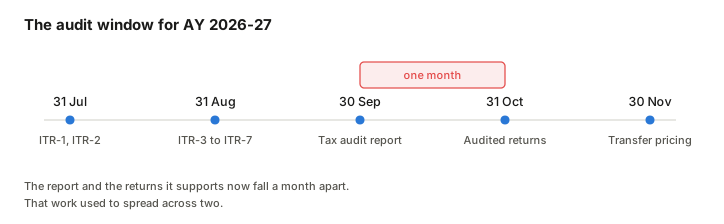
The three middle rows are the story of this autumn. The audit report is due 30 September and the audited returns 31 October, so what used to spread across two months now lands in one. Business Today reported the restructure on 17 June 2026. Deadline tracking belongs in a calendar that computes, not in a model that predicts.
The second bucket is language, and it is where the models earn their place. Client data in India arrives badly. A bank statement is a scan of a printout. A purchase invoice is a photograph taken at an angle on a shop counter. A ledger is an Excel export with merged cells and a total row in the middle. Reading that reliably was not possible five years ago and is now routine. The same models draft well: a reply to an ASMT-10, a covering letter, an explanation of an ITC mismatch pitched at a client who does not know what ITC is. None of it leaves the office without a person reading it first.
The third bucket is judgment, and it gets its own section below because it is the only one that does not move.
One signature, and a very long queue#
The standard pitch for automation assumes a firm full of people desperate for relief. That is not what practitioners describe. Article assistants are broadly fine with reconciliation work. Seniors often say they like drafting, because a well argued reply to a scrutiny notice is a craft they trained for.
The constraint is the partner, and it is structural rather than cultural. Every file passes one signature. There is no version of an Indian CA practice where it does not, because the signature is the product.
The numbers around that signature are worth sitting with. ICAI had 4,23,105 members as of 1 April 2025, of whom 1,54,552 hold a full-time certificate of practice, per the ICAI student and member report for 2025. Of roughly 99,000 registered firms, fewer than 500 have more than ten partners, and most are proprietary practices of one. Set that against a GST base that has grown from 66.5 lakh registrations in 2017 to somewhere near 1.65 crore.
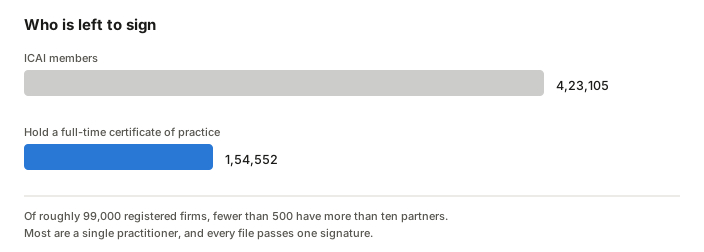
There is an uncomfortable consequence in that arithmetic, and it is worth stating before anyone buys anything. Automating the preparation does not shorten the partner's queue. It lengthens it at first, because work that used to sit behind a junior now arrives at the signature faster and in greater volume. The bottleneck does not move, it becomes visible. A firm expecting an immediate reduction in partner hours will not get one, and the only way the time comes back is by changing who reviews what, which is an organisational decision rather than a software one. Anyone selling this as an instant saving for the partner is describing something the structure does not allow.
Nobody sends a document twice#
Clients do not log in to anything. Papers arrive as a WhatsApp message at 11 pm with a photograph of a signed cheque. They arrive in a mail thread with the subject line FW: FW: RE: urgent. They arrive in a phone call where the client mentions, at the end and in passing, that they sold a property in March.
A great deal of practice management software has died on this. The product assumed the client would tag documents in a portal, and the client did not, because the client is running a factory. What makes it worse in a CA practice is that a document sent once and filed wrongly is usually not sent again. It surfaces in October, when the client is certain they already gave it to you.
Automation that requires the client to change behaviour will fail. Automation that reads what already arrives, files it against the right client and the right period, and can find it nine months later is doing the useful part.
What a model cannot read#
A model can quote a section correctly under both numbering systems. It can list the exceptions, the thresholds and the relevant rulings faster than anyone in the office.
What it cannot do is look at a client's position and see the route through. Two practitioners read the same provision and one sees a dead end while the other sees a way to make the client's plan work within the law. That is not retrieval. It is knowing this client, knowing what the assessing officer in that circle has accepted before, and knowing which position is worth taking against one that invites a scrutiny costing more than it saves.
It also cannot tell you when to pick up the phone before filing rather than after. Every experienced practitioner has a short list of situations where a call prevents a year of correspondence, and none of them are written down anywhere.
What a month would look like instead#
Set against the way a month runs today, here is what the automatable part of it could look like. Bank statements and purchase invoices arrive through the month over WhatsApp and mail, and are read, classified and posted against the right client as they land rather than in a heap on the 15th. IMS decisions are made as invoices appear, so when GSTR-2B generates on the 14th the reconciliation is a review of exceptions rather than a rebuild. Notices are matched to the client file the day they arrive, with a draft reply waiting when the partner opens it. The calendar chases the clients who have not sent papers, by name, without anyone remembering to.
The signing still goes through a person and a token. What comes back is the afternoons that used to go into getting to the point of signing.
If you run a CA practice#
Here is an exercise that costs nothing and is more informative than any demonstration. Take one client's last GSTR-2B and work out how many of the rows in it were actively decided by someone in your office, and how many were accepted because nobody looked. Then work out how long it would take to answer that question for every client you have.
Most partners have never run this, and the answer is usually uncomfortable, because deemed acceptance is invisible until it is expensive. It is worth knowing before anyone tries to sell you software.
This is the kind of work Miror does with CA firms: working out where the decisions are actually being made, then building the automations around that firm's clients, formats and habits rather than around a generic workflow. If you want to talk through what your own position looks like, write to us or message us on WhatsApp. A single real client file usually shows it faster than a demonstration would.
Stop starting
from zero.
WhatsApp usRelated