

AI for Company Secretaries in India: a ground report
·Team Miror·10 min read
Contents
There is a lot being written right now about AI doing compliance work, and most of it reads like it was written by someone who has never watched a CS try to file an AOC-4 in the last week of October.
We have spent the past year sitting inside CS firms in India and building automations for their work. This post is a plain account of what we found there: which parts of the job AI handles well today, which parts it cannot touch yet because of how the government's systems are built, and where a human still has to sit no matter how good the models get.
The government systems are the hard limit#
The work of a CS ends at a government portal, and the portals were not built for software. MCA V3 wants a DSC token plugged into a machine. OTPs go to whichever partner's phone number was registered years ago. In the week before a due date the site slows down, sessions expire, and half the office ends up refreshing the same page.
None of this can be automated in a way we would trust with a client's filing. There is no official route for a program to log in, sign with a DSC and submit a form, and the unofficial routes break every time the portal changes. If someone claims their AI files ROC forms end to end, it is worth asking them what happens when the portal asks for an OTP.
You do not have to take our word on the state of the portal. In December 2025, with the annual filing deadline already pushed to 31 December because of portal problems, ICSI wrote to the ministry again about the V3 system: validation failures on AOC-4 and MGT-7, SRNs not getting generated, prefilled data coming in wrong, timeouts during peak hours. The letter asked for urgent fixes or, failing that, a further extension to March 2026. The body representing every CS in the country was telling the government, in writing, that the filing infrastructure was not holding up in filing season.
This will change eventually. MCA has been rebuilding its systems for years and the direction is clear enough, but the rebuild is slow, and a practice cannot plan around a date that keeps moving. What a firm can do today is automate everything on its own side of the portal, which turns out to be most of the work: reading what the client sends, drafting the documents, keeping the calendar, chasing the people who have not sent their papers, and getting every attachment ready so the filing itself takes ten minutes instead of an afternoon. The submission stays manual for now, and that is a small part of the day once everything leading up to it is already done.
Pasting into ChatGPT is not automation#
The other big confusion is about what using AI means. Pasting a resolution into ChatGPT and lightly editing the output is not it. That just moves the typing around.
When we map the work inside a CS firm, it splits into three kinds, and each needs a different treatment.
Some of it is pure rules. Look at what a private company's year contains:
| Form | What it is | Due date | If it slips |
|---|---|---|---|
| AOC-4 | Financial statements | 30 days from the AGM | ₹100 per day, no upper limit |
| MGT-7 / 7A | Annual return | 60 days from the AGM | ₹100 per day, no upper limit |
| ADT-1 | Auditor appointment | 15 days from the AGM | Additional fees that multiply with delay |
| DPT-3 | Return of deposits | 30 June | Additional fees that multiply with delay |
| DIR-3 KYC | Director KYC | 30 September | ₹5,000, and the DIN is deactivated |
| MSME-1 | Dues to MSME suppliers | 30 April and 31 October | Penalties on the company and its officers |
| MGT-14 | Filing of resolutions | 30 days from the resolution | Additional fees that multiply with delay |
Every row of that table is a fixed date or a simple calculation from one. Nothing here needs a language model, and you should not want one anywhere near it, because a model can make mistakes and a date calculation cannot. The stakes of forgetting are also not small: the ₹100 a day on AOC-4 and MGT-7 keeps running with no cap, and a company that skips those two forms for three consecutive years gets its directors disqualified from every board for five years under Section 164(2). This layer belongs to plain, old fashioned automation, the kind that has existed for decades, and once it is set up it simply never forgets.
Some of it is language work, and this is where the newer AI has changed things. Client data in India is a mess. A company's master data arrives as a portal export. The auditor's consent comes as a scan. The signed page comes as a WhatsApp photo taken at an angle. Turning all of that into a correctly drafted notice, minutes in the firm's own house format, a certified true copy with the dates filled in, that is language work, and the models have become good at it. Everything they produce still gets reviewed by a person before it carries anyone's signature.
And some of it is judgment, which we will come to at the end because it deserves its own section.
The skill in automating a practice is in the sorting. A firm that puts a chatbot in charge of due dates has misused the technology, and so has a firm that pays a qualified person to retype boilerplate for years. Most firms we meet are doing some of both without noticing it.
Who actually feels the pain#
One thing surprised us when we started this work. The standard pitch for automation assumes everyone is drowning in drudgery and desperate for relief. That is not what we saw in CS firms. The people doing the drafting mostly like the drafting. A well constructed set of minutes is a craft, they trained for it, and many of them would rather be left alone with Word than have a machine take it over.
The pain sits with the founder. A CS firm grows by adding people, and every new person needs training, makes mistakes the partner has to catch, and may leave within a couple of years. The partner becomes the bottleneck through which every outgoing document passes, so the size of the firm gets capped by how many hours of review one person can do. September and October are bad months in a way only another practitioner would understand. This is the problem automation addresses in a CS firm. It is a capacity problem, and it belongs to whoever owns the practice.
The capacity problem is also getting worse on its own, because the market is growing much faster than the profession. India has more than 31 lakh registered companies, of which over 20 lakh are active. Against that, ICSI has around 75,000 members, and only about 10,000 of them hold a certificate of practice. However you divide it, each practicing professional is standing in front of a very long queue of companies. And the queue keeps growing:
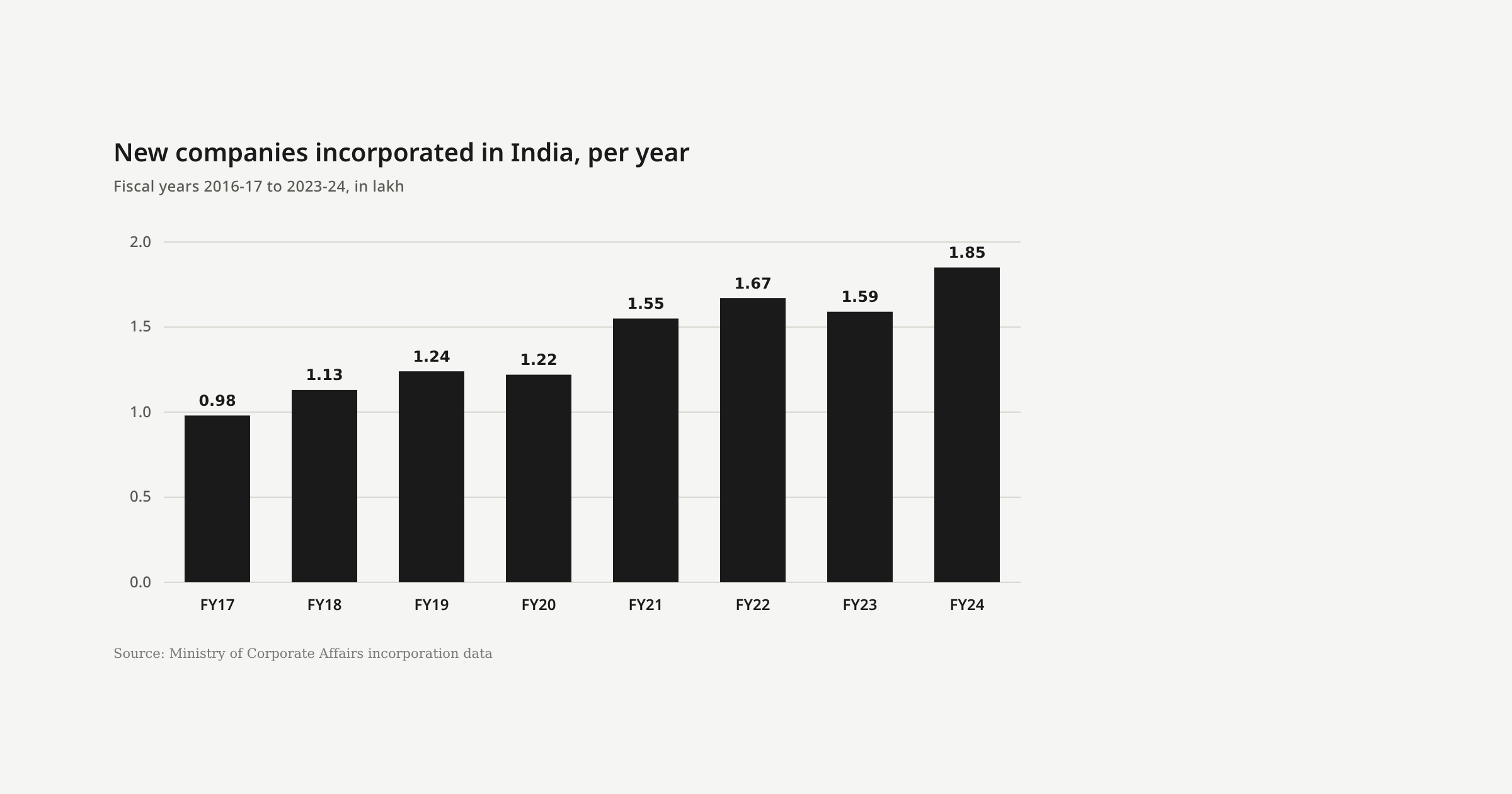
Nearly 1.85 lakh new companies were incorporated in 2023-24, close to double the figure from eight years earlier, and April 2025 set an all-time monthly record. Each of those companies arrives with a first board meeting due within 30 days and a full compliance calendar behind it. Membership of the profession grows a few percent a year. The gap between those two curves has to land somewhere, and today it lands on the same partners doing more review at night.
Which brings up the fear, because the team notices when a founder starts talking about AI, and it deserves a direct answer. The part of the job that shrinks is the retyping, the reformatting, the copying of last year's clauses into this year's file. What remains is the part that was always the real job: knowing which company needs what, by when, and what to do when something does not fit the usual pattern. In the firms we have worked with so far, the people who carry that knowledge became more central to the practice after automation, because their time stopped disappearing into production work. The person whose entire contribution was the retyping has a harder question to answer, and it would be dishonest to pretend otherwise.
The work arrives on WhatsApp#
Anyone building automation for Indian professional services has to accept early that the client will not change how they communicate. Work arrives as a WhatsApp message at 11 pm with a photo of a signed document. It arrives in a mail thread with the subject line FW: FW: RE: urgent. Sometimes it arrives as a phone call in which the client mentions, in passing, that they have appointed a new auditor and would like the filing done, and the details have to be pulled out of them with questions.
Plenty of compliance software has died on this rock. The product assumes the client will log in, upload documents to the right folder and fill in a form. Indian clients will not do this, and a CS firm cannot afford to make its clients feel like they have been given homework.
So the automation has to live behind the firm's existing channels instead of replacing them. The message still comes in on WhatsApp the way it always did. What changes is what happens after: the attachment gets filed against the right company, the tracker updates, and a draft reply is prepared for someone at the firm to check and send. The client never notices anything different, which is the point.
What stays human#
A language model can quote Section 173 correctly. It can list the exceptions, the penalties and the relevant case law faster than anyone in the office. What it cannot do is look at a client's situation and see the route through.
Experienced CSs do something that is hard to write down. Given a problem, they know which reading of a provision opens a path and which one closes it. They know when a filing can wait, and when the right move is a phone call before anything goes in writing. Two practitioners can look at the same section and one sees a dead end while the other sees a way to make the client's plan work within the law. That difference comes from years of watching how regulators, boards and courts behave in practice, and reading the bare act does not produce it, no matter how fast the reader.
Our view is that everything else in a CS practice grew up around this core out of necessity. The drafting, the registers, the calendar, the follow ups, all of it is production work that had to be done by hand because there was no other way. Now there is another way for most of it. The judgment was never the part anyone was trying to automate, and as far as we can tell it is the part clients were paying for all along.
What this looks like in a running firm#
To make it concrete, here is roughly what a month looks like in the firms we work with.
A new client company comes in, and instead of someone retyping details from an MCA printout, the master data export gets read directly and the company's file builds itself, directors, charges and registered office included. When a board meeting comes up, the notice, agenda, draft resolutions, minutes and attendance sheets appear in the firm's own format with the dates already computed, so the CS's time goes into the agenda items that need thought. The calendar carries the year on its own: ADT-1 after the AGM, DPT-3 in June, the MSME return every half year, DIR-3 KYC in September, then AOC-4 and MGT-7 in filing season, each one surfacing with its paperwork prepared and its pending items already chased.
The filings still go through a human and a DSC, because they have to. But the afternoons that used to go into preparing them mostly come back.
If you run a CS practice#
Before buying anything, sit down with your firm's work and mark which parts of it are rules, which are language, and which are judgment. Most founders have never done this exercise, and it can be uncomfortable, because a lot of billable production work lands in the first two buckets. It is still worth doing, since the split is where all the leverage hides.
This is what Miror does with CS firms. We spend time inside the practice, map its work, and build the automations to fit that firm's formats, clients and habits, then run them alongside the team. If you want to see what your own split looks like, write to us or message us on WhatsApp. One call with a real company's files is usually enough to show where the time is going.
Stop starting
from zero.
WhatsApp usRelated